
Random Thoughts
The High Individual Contributor in the Age of AI Agents
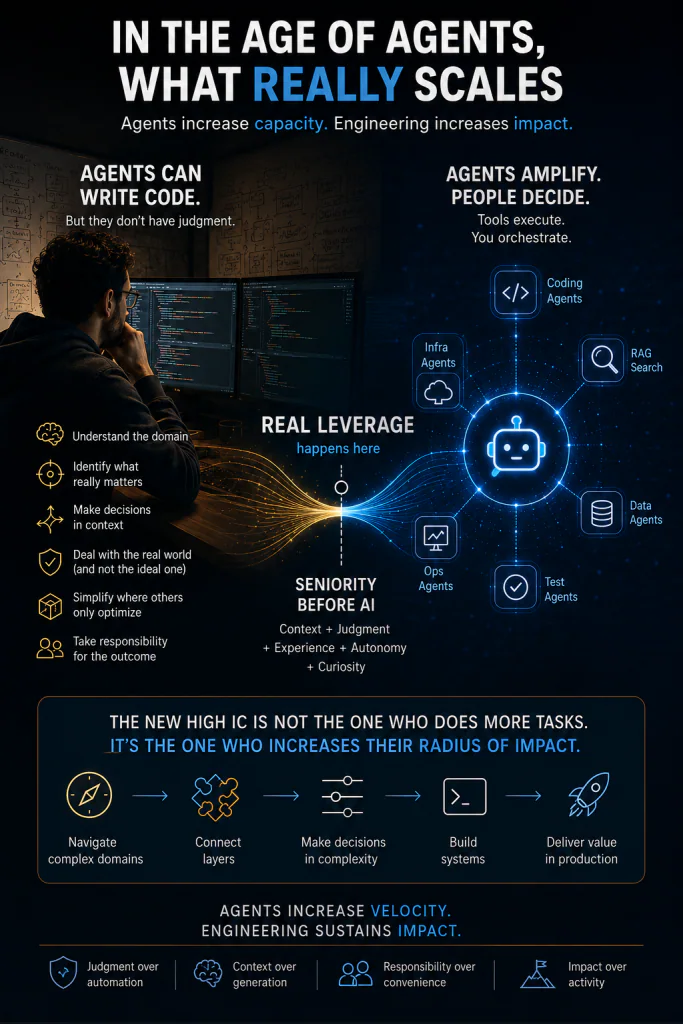
I have been thinking a lot about the role of the High Individual Contributor in the age of AI agents.
Not in the romanticized sense of the “10x developer.” And not in the simplistic narrative that AI will replace entire engineering teams.
I think the shift is more interesting than that.
And also more demanding.
Over the last few weeks, my work has moved across very different layers of software engineering: medical imaging performance, DICOM interoperability, replacing low-code workflows that became production bottlenecks, improving clinical viewers, simplifying metadata pipelines, building WhatsApp-based agents, and coordinating coding agents.
A superficial reading would be:
AI helped me do more things faster.
But I do not think that is the most important part.
The more important realization is this:
AI agents did not replace engineering. They amplified context, judgment, and autonomy.
An agent can write code.
But it does not know, by itself, which bottleneck actually matters.
It does not automatically understand when a low-code automation tool has stopped accelerating the product and started limiting it.
It does not truly understand the difference between an integration that works in the happy path and a system that must survive real equipment, real protocols, incomplete data, weak networks, constrained hardware, operational pressure, and production users.
It does not decide, with product responsibility, whether an agent inside a WhatsApp group should answer — or remain silent.
It does not naturally realize that sometimes the biggest architectural improvement is not optimizing a step, but removing that step entirely.
That is where seniority still matters.
Maybe even more than before.
AI increases speed. Seniority gives direction.
The real leverage appears when there is seniority before the AI.
And by seniority, I do not mean only being able to write better code.
I mean the ability to move across layers:
- product
- domain
- architecture
- operations
- performance
- data
- user experience
- integrations
- maintenance
- trade-offs
It is the ability to turn ambiguity into decisions.
Decisions into systems.
Systems into products.
And products into something that can survive production.
That is very different from simply completing more tasks.
The new High IC is not just faster
Maybe the new High Individual Contributor is not the person who does the largest number of tasks.
Maybe it is the person who can increase their radius of impact without outsourcing responsibility to the tool.
Because agents can increase velocity.
But velocity without judgment only delivers technical debt faster.
This is one of the biggest risks I see in the current AI wave.
Many teams are treating agents as code generators. Some are treating them as junior developers. Others are treating them as a shortcut around architecture.
But in real systems, the hard part is rarely just writing code.
The hard part is knowing what should exist.
And what should not.
The hard part is knowing when a tool has become the bottleneck.
When a pipeline should be simplified.
When a model is not reliable enough.
When the user experience needs domain-specific behavior.
When the system needs retries, auditability, observability, idempotency, or a completely different boundary.
The agent can help execute.
But someone still needs to know what good execution looks like.
Agents are not a replacement for engineering responsibility
A coding agent can produce a working implementation.
But it will not automatically carry the responsibility for maintainability, operational safety, product fit, or long-term architecture.
It does not wake up at night because a production system is failing.
It does not feel the cost of a bad abstraction that spreads across the codebase.
It does not understand the political, financial, operational, and human consequences of a technical decision unless someone brings that context into the work.
That someone is still the engineer.
Or, more precisely, the engineer who understands that software is not just code.
Software is a system of decisions.
And AI agents are making those decisions faster, more numerous, and more consequential.
That is why judgment matters more, not less.
From coding to orchestration
The individual contributor role is also changing.
A strong IC is no longer only someone who can personally implement a feature end-to-end.
That still matters.
But now the role is expanding toward technical orchestration.
The modern high-impact engineer needs to:
- decompose ambiguous problems;
- define strong boundaries;
- provide context to agents;
- review generated work critically;
- remove unnecessary complexity;
- preserve technical memory;
- choose when not to automate;
- connect product intent with system behavior;
- keep production constraints visible.
This is not “prompt engineering.”
This is engineering.
The prompt is just one interface.
The real skill is still architecture, domain understanding, product judgment, and operational responsibility.
The real leverage is not automation. It is amplified judgment.
The most valuable professionals in this new phase will not necessarily be those who use the most AI tools.
They will be the ones who know how to orchestrate agents, evaluate outputs, preserve context, simplify systems, and deliver real software in real environments.
That distinction matters.
Because there is a huge difference between:
“AI helped me generate code.”
And:
“AI helped me increase my radius of impact while keeping engineering responsibility intact.”
The first is automation.
The second is leverage.
The age of agents exposes engineering quality
The age of AI agents does not make engineering less important.
It exposes, with much more intensity, who already had engineering depth behind the keyboard.
It exposes who understands systems.
Who understands trade-offs.
Who can connect domain and architecture.
Who can simplify.
Who can operate.
Who can decide.
Who can say no.
Who can ship without pretending that production is just a larger demo.
In that sense, AI does not flatten engineering talent.
It may actually increase the gap between people who only execute tasks and people who can transform ambiguity into production-grade systems.
That is the part I find most interesting.
The future of software may not belong to the developer who types the fastest.
It may belong to the engineer who can think clearly, orchestrate intelligently, and use agents as an extension of responsibility — not as a replacement for it.
Because agents increase speed.
But engineering sustains impact.
What did this article spark?
Choose more than one and undo at any time.
Comments
Loading comments…